Friday, May 4, 2012

Grain Yield

How do we define it ? How do we measure it ? What are the units ? 


Grain yield is more complex than what most of us think. We are used to hear "I got 180 bushels/acre of corn or 50 bushels/acre of soybeans" here in the U.S. 
In my homeland (Chile), they talk about "kilos/hectarea" or "quintals/hectarea". But what are the variables that will determine the yield ?


Let's define yield first; Yield means the productivity per unit of area. The Output, the Performance.
Is the amount of harvested plant parts that we get per any unit of area of cropland and or per plant (i.e. 40 pounds of pears/tree)
It is measured in Mass unit per Area unit. Corn is Quintals/hectarea (100 kg of grain per 10,000 square meters of cropland) or Bushels/acre (32 quarts or 63 pints of grain per 43,560 square feet of cropland).


The most important variable that will determine it at harvest is Moisture (%) or Water content, measured in %, meaning how many grams of water do we have in 100 grams of vegetal product. 


Yield is the consequence of three interactions: 

  1. Environment
  2. Genetics 
  3. Agronomic Management
The environment includes the type of soil, pluviometry (rainfall), humidity, etc. The only predictible factor that will be present the next year will be the type of soil. All the others change during time and create either favorable or unfavorable conditions for pest and disease development. 


The genetics is basically the potential of a cultivar, variety, strain or hybrid of producing a maximum yield. It cannot be increased by any measure but it can be favored through good agronomics. 


Agronomic Management includes any practice such as irrigation, fertirrigation, application of fertilizers and additives (lime, strong acids, etc), cultural controls, etc. It can assist the yield by creating good conditions for the crop (soil-seed contact, seedbed, weed control, amongst others).


I hope this is helpful ! 

Friday, March 2, 2012

Know your Micro-Nutrients; how they work, get absorbed by the roots (uptake), are assimilated into the plant tissues, how to pinpoint a deficiency and its symptoms and what to do to correct a nutrient-lack situation. 

Before I start describing each and every micro-nutrient I'd like to remind you that every field is a different situation, that soil sampling is the first step in assessing and managing a farm and that if resources are available (time, money, equipment and know-how) compartmentalizing fields into homogeneous sections is ALWAYS recommended. The most important soil property that affects nutrient and mineral availability is pH (Figure 1).


If we look at the Figure 1, what can we get from it ? Ideal pH for most crops would be in the ''Very slightly acid" to the "Very slightly alkaline" or pH 6.5 - 7.5. In soils with low pH there will be a less availability of the most important nutrients (N, P, K, S, Ca, Mg, Mo) because they will be either bound to the soil coloids (Clay and Organic Matter) since the soluble forms (Soluble form is the form that the plants will uptake the elements) are positively charged or have been transformed into lose-able forms due to interactions with the Protons [H+] in the solution. . Furthermore, other Elements will be in a higher concentration (Fe, Mg, B, Cu, Zn) which can cause an adverse situation around the Rhizosphere, although those elements are needed by the plants, they need to be in extremely low concentrations. 
Management practices to correct such situation is the addition of a strong base like Lime Stone (CaCO3 or Calcium Carbonate). Another property to keep in mind while deciding whether to increase or decrease the pH of a soil is the Soil's Buffer Capacity, which is the measure (quantitative) of the resistance of the Soil solution to pH change when adding an Acid or a Base. 
  • Sulfur (S): 
    • Functions in plants: Essential for amino acid synthesis and protein formation. Necesarry for seed production, increase oil content in oilseed crops and promotes nodulation in legumes. 
    • Form used by plants: SO4-- (Sulfate).
    • Forms in the soil: Sulfate anion (SO4--), Element sulfur (S) and Organic sulfur (tied up to OM).
    • Factors leading to its deficiency: Low OM, heavy texture soils, eroded soils, cold wet or poorly drained soils.
    • Deficiency symptoms: Stunting, yellowing or chlorosis, newer tissue is yellower than older tissues, delayed maturity. Alfalfa and Corn are more affected by its deficiency due to they higher demand for this element. 
  • Magnesium (Mg):
    • Functions in plants: Actively involved in photosynthesis, forming the chlorophyll molecule. Involved in translocation of P in the plant. Regulates the uptake of other elements.
    • Form used by plants: Mg++ (Exchangeable magnesium cation)
    • Forms in the soil: Mg++, chemical compound as carbonates, oxides, bicarbonates, and silicates. Component of complex soil mineral structures.
    • Soil factors leading to its deficiency: Acid sandy soils, excessive K fertilization.
    • Deficiency symptoms: Interveinal chlorosis in the older to newer leaves. veins remain green. 
  • Calcium (Ca)
    • Functions in plants: Essential in Calcium Pectate (plant cell walls strenght), promotes root formation and leaf development, increases nodulation and bacterial activity in legumes, protein synthesis. 
    • Form used by plants: Ca++ (Calcium cation)
    • Forms in the soil: Ca++, chemical compound as carbonates, bicarbonates, oxides and silicates. 
    • Soil factors leading to its deficiency: Acid soils (Strong acid range from Figure 1).
    • Deficiency symptoms: Both root and shoot apex stunting, leaf tips can stick together and unfold abnormally. Younger growth can die back on the edges.q
  • Zinc (Zn)
    • Functions in plants: Essential for protein synthesis. Promotes seed and grain formation and plant maturity. Necessary for growth regulation and enzyme systems as a co-factor.
    • Form used by plants: Zn++ (Exchangeable Zinc Cation)
    • Forms in the soil: Zn++ held to clay coloids and OM, part of Zn mineral complexes.
    • Soil factors leading to its deficiency: Low OM soils, sandy and eroded soils, high pH, calcerous soils (Zn will become less soluble as pH surpases 7,0). High P test levels, cold wet and poorly drained soils. Compation.
    • Deficiency symptoms: General stunting by shortened internodes. Striped chlorosis (grasses) and mottling (broadleaves). Notorious in older young leaves as it is translocated to the newer growth. 
  • Boron (B) 
    • Functions in plants: Facilitates the transport of sugars through membranes, necessary for cell division and cell development, involved in plant utilization of N and P, including synthesis of nucleic acids and protein.
    • Form used by plants: BO3--- (anion)
    • Forms in the soil: H3BO3, H2BO3-, BO3---, B(OH)4-
    • Soil factors leading to its deficiency: Precipitated on soil mineral surfaces, especially the micaceous clay minerals, Low B Test (Boiling Water Extraction), sandy, low organic matter soils that leach easily, soils in high rainfall climates, high pH, drought.
    • Deficiency symptoms: Shortened internodes at the tip apix (rosette appearence).
  • Iron (Fe)
    • Functions in plants: Essential for chlorophyll formation, necessary for photosynthesis, part of enzyme system necessary for plant respiration, formation of some proteins.
    • Form used by plants: Fe++ (cation).
    • Forms in the soil: Fe++ (Ferrous) or Fe+++ (Ferric), insoluble oxides and hydroxides. 
    • Soil factors leading to its deficiency: Excessive P, Ca, Zn, Mn, Cu can reduce Fe availability. pH greatly affects its availability.
    • Deficiency symptoms: Stunting and spindly. Chlorosis of younger growth, veins remain green. Most notorious in Milo and Soybeans. 
  • Manganese (Mn)
    • Functions in plants: Essential for photosynthesis. Co-factor of several enzymes. Involved in nitrate assimilation. 
    • Form used by plants: Mn++ (cation)
    • Forms in the soil: Mn++
    • Soil factors leading to its deficiency: Very sensitive to pH. Soluble and available in acid soils. Strong acid soils can have a Mn toxicity for the plants. 
    • Deficiency symptoms: Yellowing between leaf veins, veins remain green (soybeans, edible beans, potatoes).
  • Copper (Cu)
    • Functions in plants: Essential in plant enzymes and protein synthesis. Promotes seed production. Important to chlorophyll formation. 
    • Form used by plants: Cu++ (Cation)
    • Forms in the soil: Cu+ (Cuprous cation) and Cu++ (Cupric cation). Adsorbed to clay mineral surfaces. Part of organic complexes. 
    • Soil factors leading to its deficiency: Very high pH soils. High OM % (peat, mucks). Excessive Zn, Fe, or Mn may reduce its availability. Sandy soils.
    • Deficiency symptoms: Small grains, leaf tips wilt, then die, looking like frost damage. Leaf tips stick together. Chlorosis and necrosis of youngest leaves.
  • Molybdenum (Mo)
    • Functions in plants: Required in legume nodule to fix N from atmosphere. Component of the enzyme in plants which causes Nitrate to be reduced to amino nitrogen, used in protein synthesis. 
    • Form used by plants: MoO4-- (anion).
    • Forms in the soil: MoO4-- (Molybdate) anion, pH 5-6 as HMoO4- anion. 
    • Soil factors leading to its deficiency: low soil pH, solubility declines as pH icnreases. Very sandy soils, especially high weathered soils may be low in available Mo. 
    • Deficiency symptoms: Poor nodule formation on legume roots. Pale green to yellow color of older leaves. Stunted plant growth. 

I hope you find this useful. I promise I will pin some pictures soon. 


Saturday, January 21, 2012

Sure you know about Nitrogen ?

Nitrogen (N) 

What is it ? How does the plant use it ? How to calculate N units ? What are the management plans to use it ?
How can we figure out our crop's need for N ?

All of those questions and many more are just a stroke on this amazing subject. 

It can be found in the Atmosphere as N2 (Nitrogen), N2O (Nitrous Oxide), and many other gaseous forms. 
Will be available for plants after it's been fixed to the soil solution from the air by bacteria or industrially. 
The most common form of N in the soil is in the Organic Matter (OM) and is known as the Organic Nitrogen (ON).
ON has a chemical composition that makes it really resistant to any change on its structure which makes it unavailable for plant uptake. Altough it can be converted into Mineral Ammonium (Mineralization) by soil microbes. Subsequent to this it can be converted to Nitrate (Nitrification) by microbial activity. NO3- is the predominant form for plants to uptake it, but also the most mobile and most likely leachable form. 
Some of the processes that N is subjected to in the soil are described below

  • Immobilization; Happens when there's a high C/N relation situation (high Carbon / low Nitrogen) in the corn stover or wheat chaff or any other crop leftover (usually grains). The available N in the soil will be used by bacteria in order to break down the fibers. It'll get tied up. It causes what's known as N Starvation. It is most likely to happen in no-till to reduced-till systems when the N is spread over the surface (that widens the N availability for the crop because its downward movement will depend on either irrigation or rainfall) and also because the stover accumulates on the surface over time. It is a temporary situation though so it doesn't affect the N rate in no-till or other tillage system. This explains why is is recommended to spread Urea (50 lbs/ac) right before incorporation of the residues after harvest. 
  • Denitrification: Bacteria in saturated soils (with poor drainage due to compaction, or excessive rainfall, or field depressions where the water tends to stand) use the Oxygen from the Nitrate to breath causing the Nitrate to become into gaseous N (Unavailable for plant uptake and easily loseable). 
  • Leaching: Excessive rainfall periods and poorly managed irrigation in soils with good drainage can cause this to happen. The NO3- does not bind with the soil particles (clays and OM have negative charges) and gets washed away from the root zone by the water as it infiltrates through the soil profile downward.
  • Volatilization: Any form of N that converts into gaseous ammonia (NH3+) like Urea will be subjected to this process. Spinning spreaders are timely effective when it comes to put N on the ground, but no incorporation of it will drastically increase the volatilization. 
Liquid N form 30% and 32% at $320/ton and $342/ton, how much is an N Unit ?

1 ton are 2,000 lbs. 30% of 2,000 lbs are pure N so 30% are 600 lbs. So US$320/600 lbs = US$0,53/lbs
32% of 2,000 lbs so 32% are 640 lbs. US$342/640lbs = US$0,53/lb. 

That's how the N Units are calculated, why do we need to know that value ?
To make a N recommendation, which will be the most economical amount of nutrient to apply that returns its cost in a yield increase. 

Have a good week guys ! 

Friday, December 23, 2011

Soil Fertility

Hello Everybody,


Today I'd like to talk a little bit about soil fertility. Something that seems to be a rule for most of the professionals and individuals involved in our beloved agriculture. 


There are so many type of soils, enviromental conditions (like different climates for example) and cultural practices (adopted tillage system and many other practices unknown for many).


What's the most accurate way to manage fertility ? 
And here's where many people make the 1st mistake when managing either small or large farm operations; SOIL SAMPLING. 


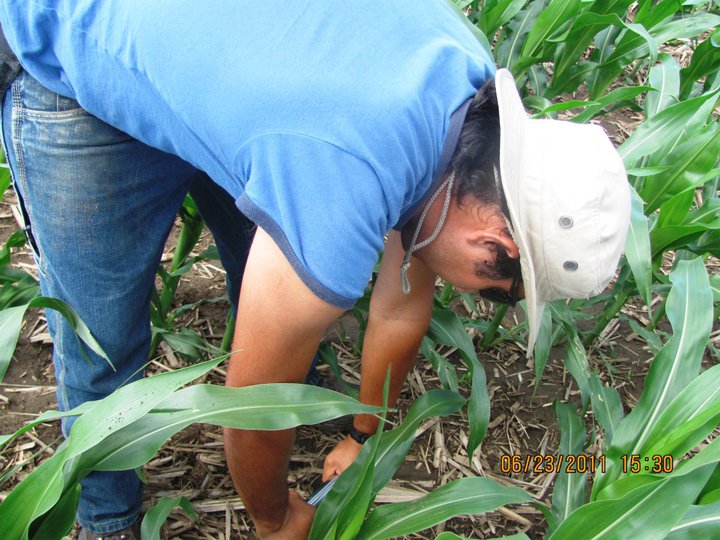
Take the soil sample with the probe


Get a descent soil core 
Put it in a ziploc bag and write date, location and field #. Do it several times so you get a few cores per bag.


 After you get your soil samples taken and submitted to the lab you'll get the results and that's the hard part, interpret the results.
My recommendation is to create a soil fertilization program according to the results that we obtain from the soil test. Knowing where we are standing at will give us a better understanding of what do we need to put down and how much of that specific item do we need.
Something really important to consider when making a nutrient program is to know the Crop Extraction Rate (I call it CER) so we can find out how much is the crop going to take away from the soil. My formula is fairly simple; Fertilizer amount = Soil Test Results - CER (expressed in ppm). If balance is negative multiply by -1.


Have a good one ! 


Welcome to my blog !

Hi everybody !


This is my new blog dedicated exclusively to discuss different subject related to agricultural production such as weed management, diseases, insects, soil fertility, plant physiology, new technologies, machinery, water, etc etc. 


Hoping you guys can find a liable source of free information in here and that you can contribute to this website with useful information.


Best Regards 


And here's a soybean field I planted this past summer 2011 in Farnhamville, Iowa ! Pretty huh ?